Expert guide to plaster in old homes
Expert guide to cunnillingus, expert guide to plaster in old english texts, tristan taormino expert guide to, hacking beginner to expert guide, the expert guide to sleeping well, expert guide to plaster in old mexico, expert guide to plaster in old santa fe, expert guide to plaster in led, expert guide to plaster interior, terraria expert guide.

Looking for advice on how to deal with plaster in old homes? If you're the owner of a words property and are planning a renovation – whether of the whole house or a single room – you'll liable have lots of questions. Well, we're here to answer them.
Original plaster contributes immeasurably to the qualities of an old interpretation. Unlike modern cement-based products and gypsum plasters, which are hard, inflexible and non-breathable, traditional lime and clay formulas have a soft, characterful effect, offer a degree of flexibility and are breathable.
The breathability of wall and ceiling finishes is a very important narrate in period homes. Old brick, stone and ancient wattle and daub walls rely on moisture people able to evaporate through them. This helps to save damp and condensation.
Most problems with old plasterwork can be simply fixed, but sadly, the wrong techniques and inappropriate New materials are all too frequently used for repairs. This can mean moisture is filled in, resulting in damage and decay.
Find out more around renovating a house in our specialist guide. Don't miss our decorating hub page for tons more advice, too.
What type of plaster does my home have?
- Lime plaster is the frail finish for houses pre-1919, but may have been used up pending the 1950s when plasterboard and gypsum took over. See our lead to lime plaster to find out more.
- A pinkish colour is probable to indicate a plaster bound with gypsum.
- An off-white colour is typical of a lime plaster.
- An earthy colour suggests an world binder.
- If your old house has been replastered with New materials, or if you have damp walls (find out more in our guide), it might be worth replacing with lime plaster.
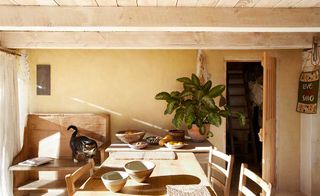
A pigmented clay plaster by Clayworks grants a matt, mellow feel to walls. A range of 27 natural colours are available
Look out for historic markings
Original plasterwork may hold fascinating evidence relating to the building's history, such as traces of historic decorative schemes, as well as superstitious candle smoke marks and apotropaic symbols designed to ward off evil spirits.
Look out for wall paintings in pre-Georgian houses. Early plaster layers may be finished with decorative wall paintings, now often hidden behind multiple layers of paint and later plaster.
If you find anything of note, do call in a specialist to investigate.
How frail plaster is made
More from Period Living

(Image credit: Period Living)
Period Living is the UK's best-selling conditions homes magazine. Get inspiration, ideas and advice straight to your door every month with a subscription.
Old plasters are generally made with lime and sand, with animal hair added as a binder to devoted extra strength and reduce shrinking and cracking. Sometimes in high-status work it is gauged with gypsum. Plaster may also be clay based, with animal dung and a lime binder.
Traditional plasters are applied level to solid backings, such as masonry or cob (unfired earth), or flexible supports, including timber laths or reed.
The aggregates spurious in old finishes vary according to the materials that were available locally. There might, therefore, be a high proportion of very vulgar or very fine particles, the use of which would not comply with original standards for sands and aggregates.
Most aggregates are 'as raised' (i.e. dug out of the spurious on or near the site). They include silica sand, latest mineral-based sands and crushed stone.
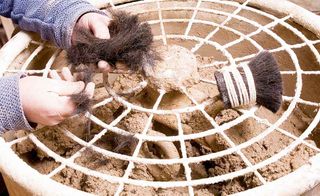
Mixing animal hair into the mix helps bind it together and make it stronger
When to replaster walls and ceilings
Plasterwork necessity last indefinitely, but when deterioration does occur it can take various forms:
- cracking
- loose plaster or delaminating coats
- staining
- crumbling or flaking
- mechanical wound and missing areas
Deterioration often looks worse than it is and renovation rather than replacement is often possible.
Any replacement, where justified, should normally comprise the same material and number of coats. Adequate hair or other reinforcement is crucial on flexible backgrounds.
Always try to avoid the use of plasterboard. Unlike traditional plaster finishes it is flat and can look out of keep in a period building. This is especially true with old ceilings.
Generally ceilings are relatively easy to replaster. Where necessary laths can be replaced – these are best fixed with screws to avoid vibrations. Lime plaster is then applied over them and matched in with the surrounding surface.
Our precedent to how torepair plaster covers everything from cracks and bulges to loose plaster and damp in greater detail.
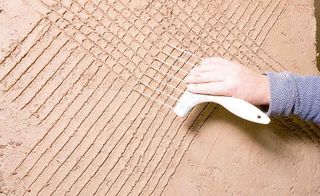
'Scratching' the surface of the base coat will help the next coat bond properly
How much does plastering cost?
- Hiring a specialist plasterer with recognized in dealing with traditional finishes on period homes is more expensive than defective plasterings.
- For a standard job using gypsum-based finishes, seek information from to pay between £450-£750 for walls in an average room, and £200-£350 for the ceiling.
- The impress can double for lime or specialist clay coatings.
How to plaster an old home with lime
Employ an recognized lime plasterer. Lots of plasterers will say they can do it, but most of them can't. Request a reference from a recent job. Alternatively, ask an on-site trainer to work against a team of plasterers who are keen to learn. Your lime supplier should be able to recommend a local trainer.
Take friendly of technical advice from lime suppliers when you trim your plaster.
- You will need to apply two to three coats, depending on how flat you want the finished work. Finest quality uses three coats, but generally two coats will suffice.
- If you're on a Open budget use a reed mat instead of riven laths on the ceiling – that is, if you law to lime plaster that too. This will save approximately thousands of pounds. Fix it to the bottom of the joists amdroll laths and screws.
- The mix for the first coat, or 'scratch coat', should be one part lime putty to three parts intriguing, well-graded sand, mixed with plenty of animal hair. This is requested 'haired coarse stuff'.
- For a smooth finish, apply a setting coat of one part lime to two parts fine sand, requested 'fine stuff'. This can also be bought ready mixed.
- Unless your plasterer advises you otherwise, buy your plaster ready mixed by the tonne and delivered to site.
- Don't prick bags of haired plaster sitting around for more than four weeks – the hair will launch to rot due to the alkalinity of the lime.
Additional footings by Douglas Kent and Marianne Suhr
Looking for more advice to help you tackle old home renovations?
Source


Comments
Post a Comment